
Upon Tides of Leaving
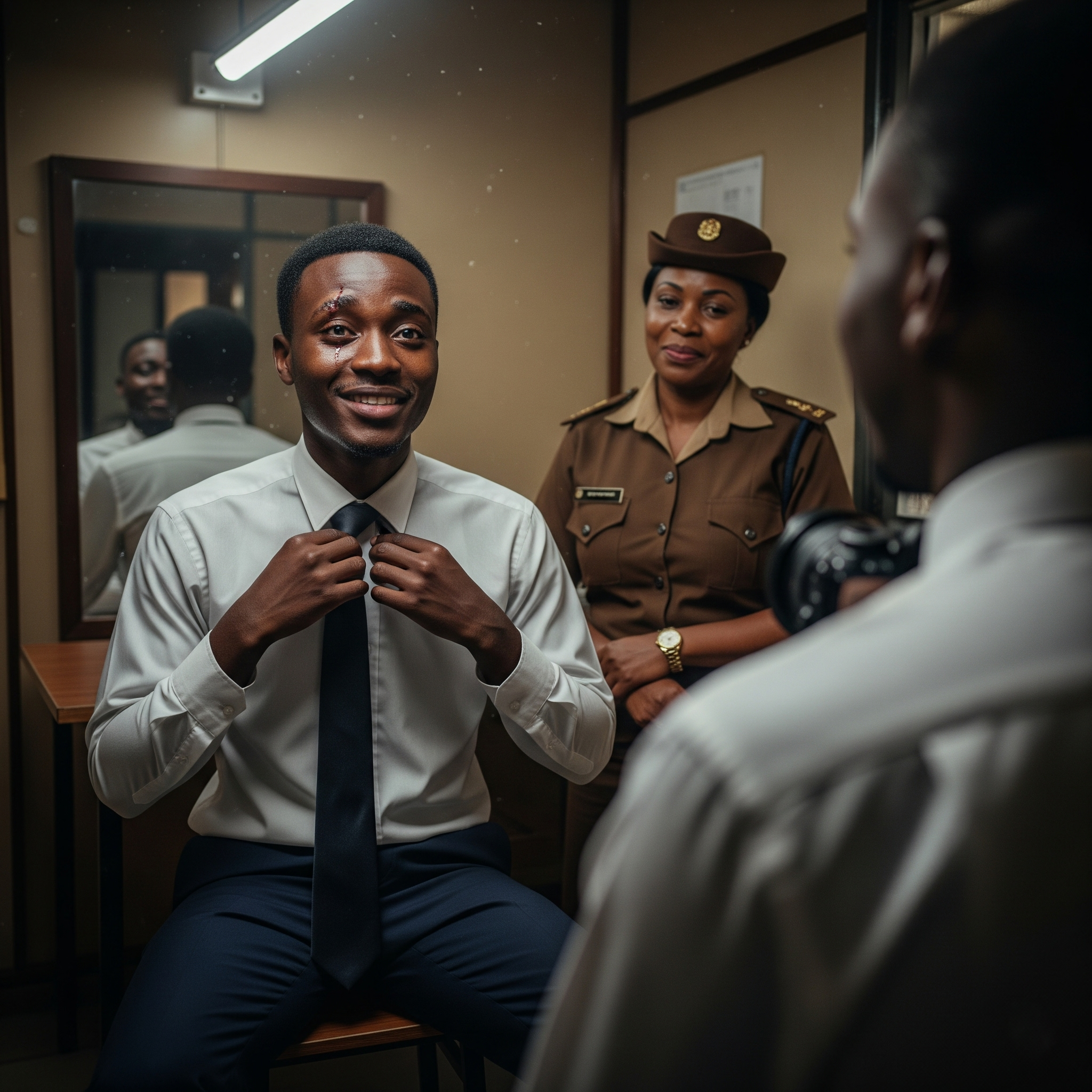
‘Make me a fine boy,’ the young man says, his tone solicitous, expectant.
Then, a cheeky grin creases his face and his eyes twinkle, as he wets an index finger with his tongue and furiously rubs at a smudge on his right cheek.
He squints into the mirror once more.
Satisfied, he swivels on the low stool he is sitting on, to face the camera set opposite the mirror.
He muses that the Passports Officer sitting behind the camera looks properly official in her starched brown khaki uniform. A hat is perched jauntily on her head the way his mother would wear hers. She is heavy-set, with a face as open and good-natured as his mother’s.
‘I will try,’ she responds, her voice deep and mellifluous, patient, just like his mother’s.
The Passports Officer leans forward, hands adjusting the camera while she regards the young man with her hooded eyes. Her lips – downturned at the corners – betray faint amusement.
He senses she is thinking: I have seen it many times before, this barely contained excitement, this desire to check-out of mother-country, swelled to the point of bursting.
Suddenly she straightens in her chair, folds her arms, and plants them firmly on her chest.
Her eyes search out his.
In the instant that the young man’s gaze is arrested by the Passport Officer’s, time sharply slows and his heart accelerates.
The ticking of a clock suspended precariously above the door grows so loud, he can hear it inside his head and feel it in his heaving chest. The walls of the room seem to fall away and the stark familiarity of all the young man’s years in this world come flooding into the room.
A voice coming faintly from the foyer suddenly becomes a magnified echo. The voice has the same timbre, the same gusto as his father’s voice.
‘wen our turn go reach to do our passport sef? Somebody else has jumped the queue, not so?’ It asks.
Then it continues, ‘na wa for dis our kontri. Na so we dey do… man- know- man. This country is dead by our own hands.’
The voice breaks into laughter. It is a long, rumbling, belly laugh, same as would happen whenever his father speaks with self-deprecation, or shares one of his ribald jokes, a hand partially covering his mouth, wicked glint in his eyes.
The voice’s casual self-awareness, its care-free fatalism, finds the young man at his core and connects with him to such an extent that he feels one with the voice.
The voice seems to meld with the smell of bean cakes and spiced vegetables, same as he saw being eaten by an officer at the front desk when he arrived. It is a heady and hypnotic mix which momentarily whisks the young man back to the predictable mornings and taken-for-granted pleasures, the humbling immediacy of his childhood.
His eyes sting and he takes a deep breath, letting the air out in spurts to slow the rapid thumping in his chest.
Suddenly, the young man can make out another voice. It is the Passport Officer’s voice, a gentle insistence, pushing aside the voice from the foyer.
‘I am ready when you are. Chin up and adjust your tie,’ she says.
She is looking at him the way his mother would, with knowing in her hooded eyes and empathy etched across her brow.
‘In a moment,’ he responds.
He shakes his head vigorously, shrugs his shoulders to straighten his back and breaks into a smile, his own eyes diamond-bright, amid their tears.